For Our Grandchildren and Theirs:
Navigating Shadow, Us-vs.-Them, &
Other Threats to Democracy
Origins, Philosophy, Intention, and Approach
The intention and philosophy of the course have their origins in 2016 and 2018 in two essays about the collective shadow of the United States. The essays evolved into a book, Healing America’s Narratives: The Feminine, the Masculine, & Our Collective National Shadow (2022), which evolved into a series of public lectures (2022-present), additional essays on Medium through October 2023, and on Substack thereafter, and courses at the Osher Lifelong Learning Institute at the University of Connecticut, Waterbury (Spring 2024-present).
At the core of the tension between the dignity of every human and a power structure that values money, things, and beliefs more than people is what millions of Americans don’t see or won’t acknowledge about the nation—the collective national shadow—which renders not surprising (although perhaps shocking), the events of the 21st century, as well as much of what preceded it. We are not reducing the nation to its shadow. We are doing the essential work of addressing the shadow.
“The shadow is that part of us we fail to see or know…. that which has not entered adequately
into consciousness…. The shadow gone autonomous is
a terrible monster in our psychic house.”
– Robert A. Johnson, Owning Your Own Shadow (1991)
Our general intention is to shed light on the shadow—to recognize, understand, own, and integrate it—in order to move toward wholeness and to ensure that the more perfect union we continue to attempt to establish is increasingly more integrated, whole, balanced, and clear in its complex unfolding.
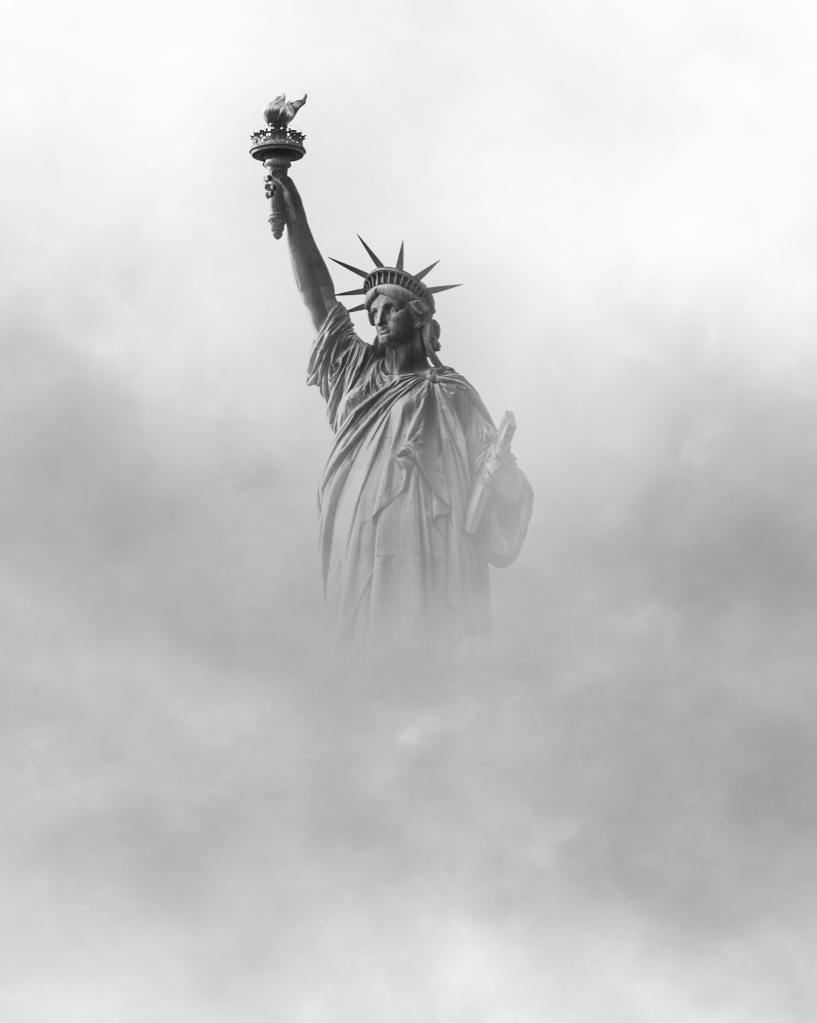
The Foundations of Liberty Are Harder to See – Photo by Tom Coe on Unsplash
“Everyone assumed [in the 1990s] that in a more open, interconnected world, democracy and liberal ideas would spread to the autocratic states. Nobody imagined that autocracy
and illiberalism would spread to the democratic world instead.”
– Anne Applebaum, Autocracy, Inc. (2024)
The course invites us to:
- engage an unvarnished, good-faith approach to understanding history and current events. Among the areas we’ll explore are the foundational subjugations of women, Indigenous Peoples, Africans and African Americans, and the poor; the Vietnam, post-9/11, and subsequent wars; the CRT/DEI/woke/cancel extravaganzas; the dismantling of democracy; generally othering others; and planetary ambivalence
- recognize ourselves as humans, citizens, and primary “instruments” in our explorations and understandings of history and current events, which requires that we explore and engage in good faith at least basic levels of critical thought, self-reflection, self-awareness, and self-compassion, and that we attend to our own development through intentional practice. We’ll do this in part through an exploration of questions and statements that include, among others: Who am I, really? Everything is a story. How do I choose to be? What am I missing? What’s my impact & what impacts me? Who are my people? I am going to die. How am I in relationship with all of this?
- honor and engage the essential role of witnessing and testifying on behalf of ourselves and others, whether we are impacted directly, indirectly, or (apparently) not at all (yet) by what we observe.
- be willing to do the work of integration—of embracing our own development, what we learn, and who and how we are—in order to bring increasingly comprehensive, inclusive, balanced, and complex ways of being to what we observe, how we assess, what we do, and who we think we are as citizens and human beings.
“All social structures that male society has built so far have included within them the suppression of other men…. What a relatively few men in our advanced society have
been able to build has been at the great expense of other men.”
– Jean Baker Miller, Toward a New Psychology of Women, (1976)
Get in touch to register, to have a conversation, or to find out more. No strings attached, knotted, dangling or otherwise.
Find all the course details—description, schedule, registration, & tuition here.

Workers at Yosemite Protest the Gutting of the Federal Workforce

